
How to Track Your SEO ROI: A 3-Step Guide for Business Owners
Your SEO is either making you money or losing you money. The scary part is: most businesses don't know which. Here are 3 ways to check your SEO ROI.
Updated:
Mar 16, 2026
You're being charged $500 to $2,500/mo by your SEO agency.
And every month, you get a report with "vanity" metrics like your traffic and rankings.
But does your marketing agency tell you how many qualified leads you got from SEO? Do you know how much revenue those leads generated?
If the answer is "No", you must learn how to measure SEO ROI (return on investment).
We know that SEO can yield an average 748% ROI ($7.48 back for every $1 spent), according to data from Design Rush.
Are you even close to this? In just 3 steps, I'll show you how to track your SEO ROI. This is a tried-and-true formula used by the 18+ SEO specialists at my marketing agency, Comrade.
Key Takeaways
- Track your SEO ROI to ensure your SEO is actually making you money.
- Factor in an accurate investment by including tools, agencies, and in-house salaries.
- Track leads and revenue in GA4 to connect organic traffic directly to conversions.
- Measure performance regularly by calculating SEO ROI monthly or quarterly.
- Target long-tail keywords to reach the most qualified leads.
What Is SEO ROI?
SEO return on investment is a metric that measures the profitability of your search engine optimization. It compares the revenue generated from organic search traffic against the total costs of your SEO.
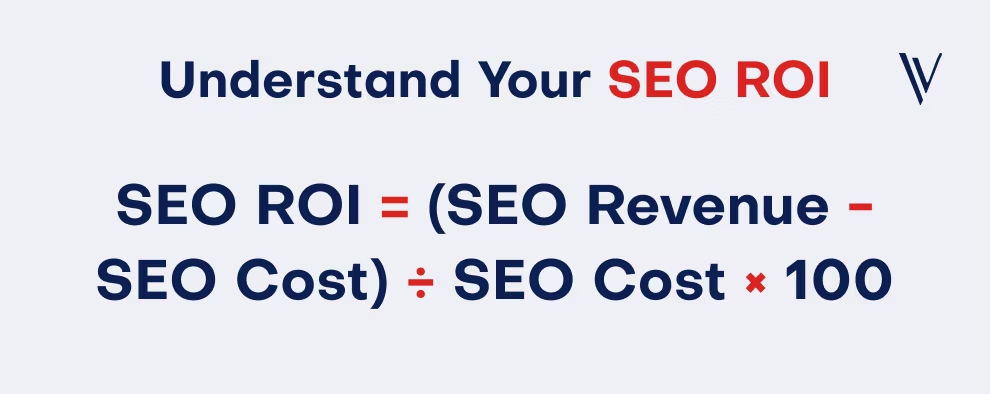
The formula: SEO ROI = (SEO Revenue − SEO Cost) ÷ SEO Cost × 100
Quick example: You spend $5,000/month on SEO and generate $20,000 in revenue from organic traffic.
($20,000 − $5,000) ÷ $5,000 × 100 = 300% ROI
I want you to think of it like any other business investment.
You put money in (agency fees, tools, content, time) and you expect more money to come out (in the form of leads, sales, and long-term customer value).
SEO ROI tells you whether that exchange is actually working in your favor! That's why it's essential to track the right search engine optimization metrics.
Want to increase ROI marketing across every single channel? Check out my latest guide.
The Real Importance of SEO ROI in 2026
I can't repeat this enough: Don't measure ROI SEO to just prove your agency is worth the retainer.
The rabbit hole goes way deeper when you actually track the success of your rankings and leads from search engine optimization results.
- It tells you what's actually driving revenue: Like leads and jobs! SEO leads should close at a 14.6% rate at least. That is only visible when you're tracking ROI.
- It justifies your marketing budget: When you can show $7 back for every $1 spent, investing more feels comfortable, exciting even!
- It exposes dead weight: Keywords, pages, and campaigns that set fire to your money without converting get cut fast when ROI is your north star.
- It keeps your agency accountable: Only 36% of marketers can accurately measure ROI, according to Firework. Knowing your ROI helps keep your agency accountable.
- It gives you a competitive edge: Over 1/3 of companies rarely or never measure the ROI of their marketing spend. Now you have an edge!
Neil Patel, who has been doing SEO for over 20 years, said something to marketers that holds true for small business owners, too: "Don't optimize for conversions, optimize for revenue."
As a small business owner myself, I know how important it is to understand whether you're seeing a positive or negative return on investment.
That's exactly what measuring SEO ROI guides us to do!
What If... You Saw an 820% Return on Your SEO Investment?
It's Possible! Contact My Team Now.

How to Measure SEO ROI the Right Way
18 years and 330+ clients later, I've boiled it down to 3 steps.
What you're about to see is a practical marketing ROI calculation that tells you exactly what your SEO investment is worth and where to put your next dollar.
Calculate Your Total SEO Spend
When I first started learning marketing around age 12–13, I thought SEO costs were simple... whatever you paid an agency.
Turns out, that’s only part of the picture.
If someone on your internal team spends time on SEO (even if they split their time between SEO and other marketing work), that portion of their salary counts too!
To accurately calculate SEO ROI, you need one complete number that captures every dollar tied to your SEO efforts. Here's what goes into it:
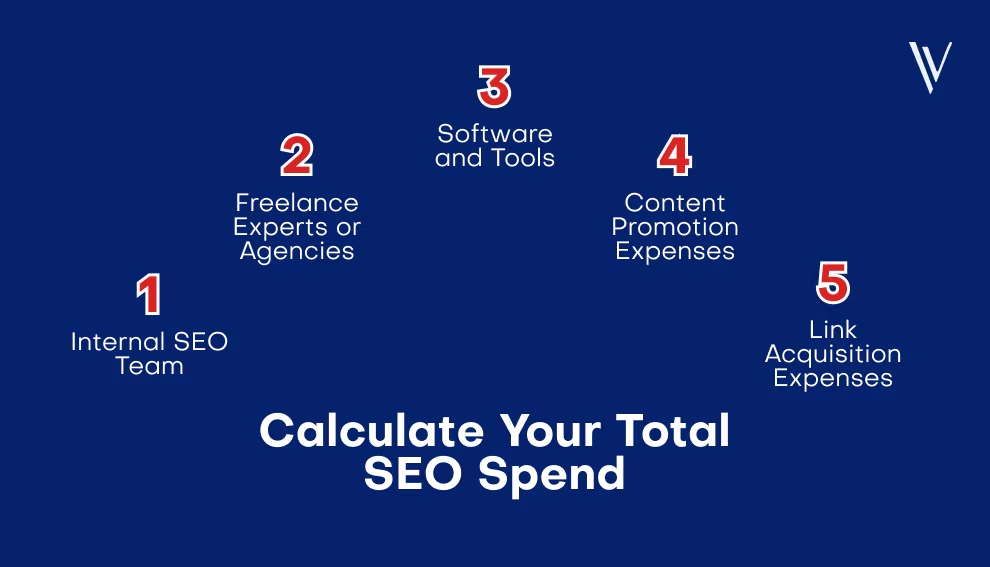
Internal SEO Team
In-house SEO costs go beyond just salaries.
To get a true ROI for SEO, include benefits and the exact portion of each team member's time spent on SEO activities.
A content manager splitting time 50/50 between SEO and email... count 50% of their cost. By the way, general marketing overhead doesn't count here. Factor in only what's directly tied to SEO.
And consider your involvement: Take into account if you write, review, edit, or approve SEO content.
Freelance Experts or Agencies
SEO agency costs and freelance SEO pricing both belong here.
Ahrefs says the average monthly fee sits at $3,209 for agency-led programs and $1,348 for freelancers.
Include every retainer, project fee, and consulting cost you've actually paid out. ROI on SEO only stays accurate when you're working with confirmed data, not estimated or projected spend.
Software and Tools
ROI SEO tracking must factor in your SEO software expenses.
This would include Ahrefs, SEMrush, Google Search Console, Screaming Frog, Surfer SEO... literally any platform used for analytics, keyword research, rank tracking, or technical SEO.
Make a list, then add up all recurring subscription costs and include them in your total.
Content Promotion Expenses
Gone are the days of "If you write it, they will come."
Today, money talks. Content promotion is vital, and this covers paid SEO content distribution.
Think about native ads, sponsored placements, and paid amplification of SEO content; these ALL factor into the ROI of SEO.
And no. Organic social posts and internal email sends DO NOT count, unless you're paying to boost them.
Link Acquisition Expenses
SEO link expenses take into account the costs tied to earning backlinks.
As per the E-Learning Industry, one quality backlink could cost as much as $500 on the higher end.
I personally take into account outreach tools, placement fees, digital PR campaigns, and link-building services.
Add every dollar spent here to your total SEO spend to arrive at your SEO ROI.
Stressed About Your ROI?
Want Highly Qualified SEO Leads Faster? Contact My Team.
Implement Conversion Tracking
Shopify's senior SEO lead, Kyle Risley, once said: "For any sales-based business, every metric must be grounded in revenue. Rankings matter only because they influence that outcome."
That's precisely why conversion tracking is vital before you calculate SEO ROI. Without it, Google Analytics is just showing you traffic.
Last I checked, "traffic" won't keep the lights on.
Here's a simple conversion tracking setup:
Lead Generation Conversion Events
To measure SEO ROI, you must track what happens after someone visits your website.
I recommend starting with Google Analytics (GA4). This is Google’s analytics platform that tracks how visitors interact with your website and where they came from.
Send your marketing team or SEO agency this article. They should ensure that "conversion events" are properly configured in Google Analytics.
These events track actions like:
- Contact form submissions
- Phone call clicks
- Quote requests
- Live chat conversations
Once these actions are tracked, Google Analytics can attribute them to a specific traffic source, like organic search.
This is critical because it shows you exactly how many leads your SEO is generating.
Not Every Conversion Is a Qualified Lead
Here’s something I’ve personally seen many businesses miss.
Just because someone fills out a form or calls your office doesn’t mean they’re a qualified lead. Some inquiries may be:
- Spam submissions
- People outside your service area
- Prospects looking for something you don’t offer
That’s why I strongly advise implementing lead qualification as part of your ROI tracking process.
Lead qualification can be handled by:
- Your intake team or receptionist
- An internal marketing manager
- Your SEO agency
- Or an automated system that filters leads
Without qualification, your data can easily become misleading.
Assign a Dollar Value to Each Qualified Lead
Once you identify qualified leads, the next step is assigning them a real dollar value.
My recommendation is to use your average deal value and historical close rate.
For example, if your average client is worth $5,000 and your team closes 20% of leads, then each qualified lead is worth about $1,000.
You can now clearly see how much revenue your marketing channel is producing.
Use a System That Tracks Qualified Leads Automatically
Manually qualifying leads can take time, which is why I often recommend using a system that automates the process.
At my agency, Comrade, we built a proprietary system called a Growth Portal specifically for this. Our system automatically:
- Tracks every lead generated from SEO
- Filters out low-quality or irrelevant inquiries
- Shows exactly how many qualified leads your marketing produced
Once a dollar value is applied to those qualified leads, the dashboard can also estimate projected revenue generated by SEO.
Calculate Your SEO Return on Investment
You've got your total SEO spend. You've got conversion tracking pulling in real revenue data.
Now it's time to put them together and calculate your SEO return on investment! Here's the SEO ROI formula:
SEO ROI = (SEO Revenue − SEO Cost) ÷ SEO Cost × 100
Let's break down each variable:
- SEO Revenue: Total revenue attributed to organic search traffic in GA4: purchases for ecommerce, or lead value × conversions for lead gen.
- SEO Cost: Your complete SEO spend figure from Step 1: agency fees, tools, content, labor, link acquisition, all of it.
- The result: Your ROI expressed as a percentage.
Quick example:
- Monthly SEO spend: $5,000
- Monthly revenue from organic traffic: $25,000
- SEO ROI = ($25,000 − $5,000) ÷ $5,000 × 100 = 400%
That means for every $1 invested in SEO, you're getting $4 back. You can do this monthly or quarterly, depending on your sales cycle.
Why is all of this important? All Out SEO explains, "SEO remains the highest ROI channel. High-value industries like medical, SaaS, and legal show multipliers above 700–1,000%!"
Properly tracking SEO ROI reveals if you're within or falling short of your industry's range.
Your Next Step
Get More Qualified Leads with a Pro SEO Company.
Common Obstacles to Calculating SEO ROI
I'll admit it: Measuring the ROI of SEO is HARDER than measuring paid channels.
Here are the 5 most common obstacles that throw off your numbers:
- Attribution gaps: Your prospect finds you on Google, leaves, comes back 2 weeks later through a direct link, and converts. Most analytics tools credit the direct visit, not SEO. Your organic ROI will get undercounted every time this happens.
- Long sales cycles: The average B2B customer needs 62+ touchpoints before converting! SEO activity in month 1 may not show up as revenue until month 3.
- Assisted conversions: SEO often starts the buyer journey without closing it. If you're only measuring last-click conversions, you're missing every deal SEO helped start. This is "invisible credit."
- Offline conversions: Phone calls, walk-ins, and in-person sales triggered by organic search rarely make it back into GA4 on their own. Start using a call tracking tool like CallRail.
- Keyword (not provided): Google encrypts most organic search data, so you often can't see exactly which keywords drove which conversions. Frustrating but workable with the right setup!
Okay, I just threw a lot at you.
Here's the bottom line: SEO builds value over time (typically 6+ months) and across multiple touchpoints.
That's why you need a little patience when measuring the ROI of SEO... more than you would a paid ad campaign.
SEO ROI Insights Across Industries
I want you to understand that the ROI for SEO isn't cut and dry.
I've worked with 300+ businesses across dozens of industries, and the returns vary wildly depending on your sales cycle, competition, and average deal value.
But SEO compounds. Invest now, and you'll reap the rewards for years to come.
ROI of SEO for Small Businesses
Are you running a small business with a shoestring budget? Small business SEO ROI can be extraordinary!
Take a local fencing company investing $3,500/month in SEO. Within 12 months, they could handily generate $25,000/month in revenue from organic leads with good SEO. That's a 614% ROI.
For small businesses, local visibility is everything. SEO keeps working for years, lowering your customer acquisition costs in a way that paid ads cannot.
SEO ROI for Home Service Businesses and Contractors
If you're a contractor, your local SEO ROI can be sky-high!
Take Cedar Rustic Fence, a Midwest-based fencing company. In under 12 months, they saw a 4,618% marketing contractor SEO return and a 461% increase in qualified leads. Every dollar they put into SEO kept compounding.
They no longer had to rely on referrals or expensive paid ads.
Want to increase your ROI faster? Read my guide on home services marketing ROI.
SEO ROI for Franchise Companies
Gunning for a multi-location SEO return? This is where SEO really starts to go wild!
A realistic multi-location SEO budget runs about $3,500+/month per location (so a franchise with 5 locations is looking at a $17,500/month SEO investment system-wide).
Mind you, that's a conservative estimate. But multi-location SEO returns are high!
In my experience, local franchise marketing pays you back.
It focuses on 3 things: one centralized strategy, localized execution per location, and compounding returns that grow with every new location added.
Is Your SEO Agency Giving You Excuses?
We Give You an Avg. 820% Return on Investment.
5 ROI-Focused SEO Strategies That Work
You have the formula. The tracking setup. And the benchmarks.
Now you need the strategies that actually put money in your pocket!
Bear in mind, search engine optimization ROI doesn't care about how much traffic you're getting.
It cares about how much revenue the traffic generates. Every strategy below ties directly to leads, conversions, and revenue. Let's go.
1. Audit & Optimize Your Website Performance
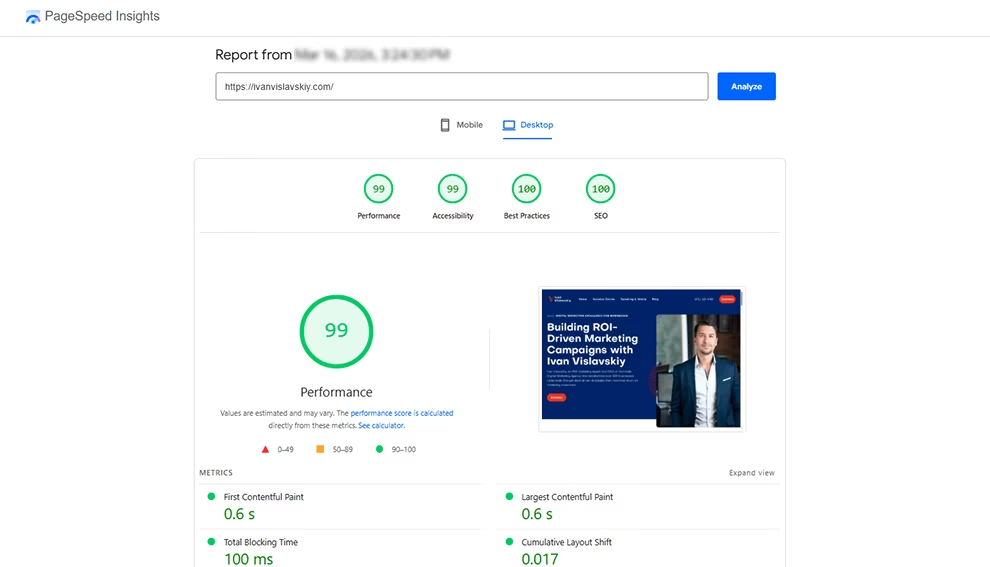
I love the "under the hood" stuff.
A technical SEO audit is the unglamorous first step... but your ROI SEO will plateau if you skip it.
As per Portent, a 1-second load time on your website delivers nearly 40% conversion rates. Wait just one more second, and that drops to 34%!
Fix these 4 things first:
- Page speed optimization: Anything under a 90 on Google PageSpeed Insights is bad.
- Mobile usability: Google has admitted it uses mobile-first indexing for its organic search results. Make sure your site is mobile-friendly.
- Indexation errors: Blocked pages can't rank. Crawl your site with Screaming Frog.
- Conversion friction: Make sure your contact buttons are instantly visible, and your forms have a maximum of 3 fields.
Scratching your head over how to get AI to recommend your business? Read my guide!
2. Target High-Value Keywords Strategically
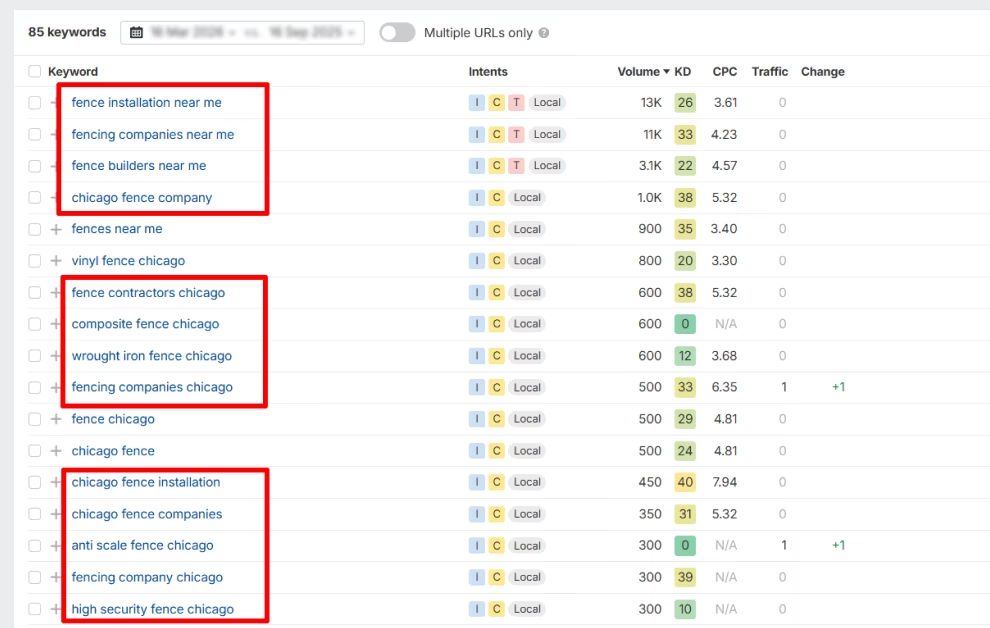
I've seen hundreds of businesses that run after high-volume keywords that bring in thousands of "visitors"... only to see 0 paying customers.
That's a crappy SEO keyword strategy. You don't just need leads. You need qualified leads.
ROI in SEO comes from revenue-driven keywords.
This is why I stress on long-tail keywords that convert at an average rate of 36%. P.S. That's nearly 2.5x higher than short-tail keywords.
Think about what that means for your bottom line.
- Traffic-driven keyword: "what is a fence" is a high-volume, zero buying intent keyword.
- Revenue-driven keyword: "vinyl fence installation cost Chicago" is a lower volume, red-hot buying intent!
A keyword with just 50 monthly searches and high intent, converting at 36%, could deliver 18 new job inquiries! Prioritize commercial and problem-aware search terms.
And if you want to get serious about ranking, read my Google ranking up guide now.
3. Optimize Your Presence for AI-Driven Search
Of course, we have to talk about AI.
AI Overviews at the top of Google are reducing organic click-through rates by 58%, per the SEO experts at Ahrefs.
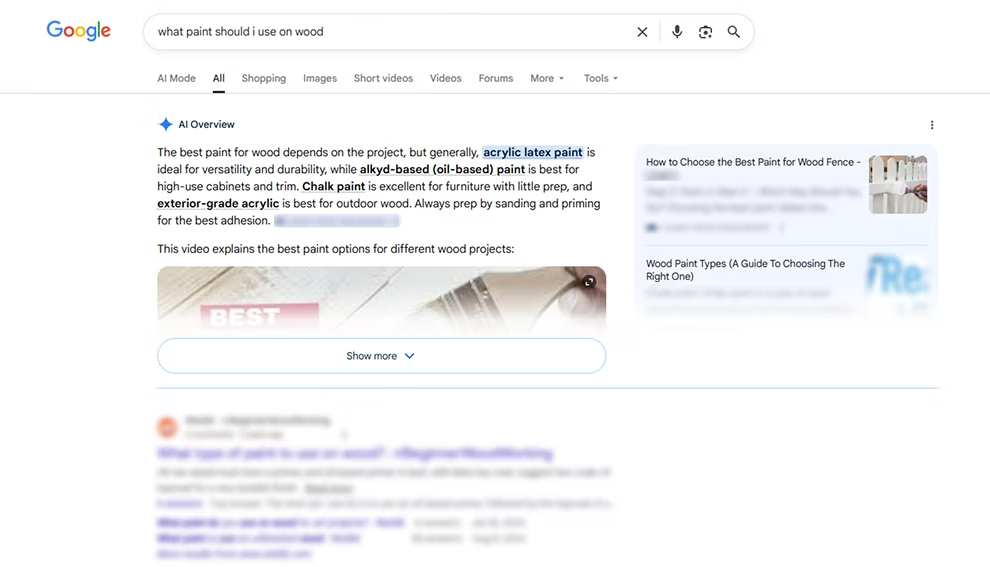
The ROI for SEO in 2026 goes beyond page-one rankings. Today, you have to be the guy AI likes enough to mention!
I recently read a stat that confirmed: Brands cited in AI Overviews earn 35% more organic clicks and 91% more paid clicks.
AI search optimization is crucial to get those clicks. Here's how to get cited in AI Overviews:
- Structure content for direct answers: Use clear headings, Q&A formats, and concise definitions.
Green Apple nailed it with their landscaper FAQ page. They cover common questions along with direct, concise answers. AI loves this!

- Build entity authority: Be consistent, accurate, and thorough across every page.
- Earn trust signals: Reviews, backlinks, and E-E-A-T all influence AI recommendations.
Want to catch AI's attention? Read my full guide on answer engine optimization.
4. Build Quality Backlinks for Authority
Backlinks contribute to better SEO ROI.
Simply put, a backlink (or an inbound link) is a link from another website to yours. The more credible the site linking to you, the more Google trusts you.
First Page Sage reports that you need an average of 521 backlinks to have a hope of ranking in the top 3 spots on Google.
But one backlink from a respected, relevant site in your industry is worth more than 500 links from low-quality directories.
Here's why backlinks matter for long-term ROI:
- Ranking stability: High-authority links act as a buffer against algorithm updates; your search engine rankings hold while competitors drop.
- Cost efficiency: Earned authority compounds over time, meaning your cost per lead keeps falling as your domain strengthens.
- Trust signals: Authoritative links reinforce your E-E-A-T (Experience, Expertise, Authoritativeness, and Trustworthiness), a direct factor in how Google evaluates and ranks your content.
Trust me, your SEO ROI depends on key factors like gathering quality backlinks. So, whatever you do, do not skip this digital marketing tip.
5. Create Bottom-Funnel Content That Closes Deals
Most businesses pour their money into top-of-funnel content.
This covers blog posts, guides, and educational articles that attract traffic but rarely convert.
Instead, create conversion-focused content that meets buyers head-on!
This is how you increase SEO ROI without increasing traffic. Bottom-funnel content includes:
- Service pages: Clear, specific, and built around what your ideal customer is searching right before they hire someone.
- Comparisons: "X vs Y" pages that help buyers make decisions. You help them for free. They choose you when the time comes.
- Pricing context: As Repsly points out, "Cost transparency makes consumers feel like they have an ‘in’ with the company, increasing their willingness to pay."
- Proof points: Case studies, reviews, and real results are vital. Nav43 confirms that pages with social proof have a 2-3 times higher conversion rate!
Want ChatGPT to choose you? Read my guide on how to create AI-optimized content.
Final Nudge
Grow Your SEO ROI to 820% on Avg. with Expert Help!
Is SEO Important in the Age of AI?
With tools like ChatGPT, Perplexity, and Google AI Overviews changing how people search, I often hear the question: Does SEO still work?
Absolutely. Roughly 80% of AI visibility is built on SEO foundations.
In fact, SEO is even more important now. What many people don’t realize is that AI search relies heavily on traditional SEO signals: strong content, authority, backlinks, and topical expertise.
I recommend thinking of SEO ROI and AI ROI as related but separate.
Without strong SEO, it’s much harder to appear in AI-generated results.
Enough Talk. Let's Boost Your SEO Returns in 2026.
I won't sugarcoat it for you.
SEO is a complex game. It takes 15+ years to crack the code on how to measure SEO ROI.
Meanwhile, there are 100+ SEO ROI metrics telling you where to invest, what to cut, and when to scale.
Why not turn to a pro? My team at Comrade has done it for 330+ businesses.
Take Apex Windows: with a focused local SEO and content marketing strategy, they saw a 7,841% ROI... absolutely crushing their competition!
Come see what's possible for your business. Book a consultation and let's scale your leads, revenue, and profits together.
FAQ
.png)
Ivan Vislavskiy is a business growth expert with 18 years of experience. He is also CEO of the award-winning Comrade Digital Marketing. Alongside his team, he’s transformed 300+ businesses across the U.S., with a special focus on the home services niche. His approach is ROI-driven, fully transparent, and built to drive real-world business outcomes.
Schedule a session and skyrocket your business today.

![GEO vs SEO: How to Double Your Profits in 2026 [Small Business Edition]](https://cdn.prod.website-files.com/673af32f3d0a33dd056406ce/693a63b8be62ea9d6e9bb15a_geo-vs-seo.avif)
.svg)