
GEO vs SEO: How to Double Your Profits in 2026 [Small Business Edition]
AI is changing how customers find businesses! This shift is happening faster than most business owners realize.
Updated:
Dec 11, 2025
For over 20 years, SEO has been the king of online visibility. But today, a powerful new player has entered the arena: GEO (Generative Engine Optimization).
While SEO helps you rank on Google, GEO helps you appear inside AI-generated answers, namely, the answers people get from ChatGPT, Gemini, and Perplexity.
AI tools now process over 1.5 million prompts per minute. If your business doesn’t appear in these AI answers, you’re missing a rapidly growing segment of your market.
Today, I’ll break down the difference between GEO vs SEO, and show you how small businesses can use both to grow their profits in 2026.
What is Generative Engine Optimization?
If you’re wondering, "What is GEO?” or "What does GEO even mean?" — here’s the simple version:
Generative Engine Optimization (GEO), also known as Answer Engine Optimization, is the process of optimizing your business to appear in AI responses.
When someone asks: "Who’s the best roofer near me?” or “Top injury lawyer in Chicago", AI engines don’t show you 10 blue links as Google does. They give 1 to 3 recommendations.
Not included there? You're not getting hired.
So, how do you become GEO-friendly? I recommend focusing on these strategies:
- Write clear Q&A-style content that AI can extract
- Use specific language (business name, service, city), so you’re recognized as an entity
- Add structured elements like FAQs, bullet steps, and definitions
- Keep details consistent across your site, Google Business Profile, and directories
Why GEO Matters Now
Zero-click searches are exploding. People get answers instantly on Google AI Overviews without clicking a link.
On top of that, 27% of people now skip Google and use AI tools like ChatGPT or Perplexity.
Great SEO isn’t enough anymore. You can rank #1… and still miss a ton of leads if AI doesn’t mention your business inside its answers.
And as Marc Benioff, CEO of Salesforce, says, “Artificial intelligence may be the most important technology of any lifetime.”
He's not wrong, given that in just one year of launching, ChatGPT already had 1 MILLION weekly active users... soaring to 800 million just 3 years later.
GEO vs SEO: The Key Differences Small Businesses Should Understand
SEO and GEO drive visibility in different places.
You cannot succeed with GEO unless you already have a strong SEO foundation. SEO is the base. GEO is the amplification layer.
Without SEO:
- AI models can’t verify your entity
- They don’t trust your content
- They won’t mention your business
- GEO simply won't work
How SEO and GEO Work Together
SEO builds authority, structure, and trust. GEO uses that authority to feature you inside AI answers.
You need both strategies. If you’re missing either, your visibility evaporates across an increasingly fragmented search landscape.
Where Your Customers See You
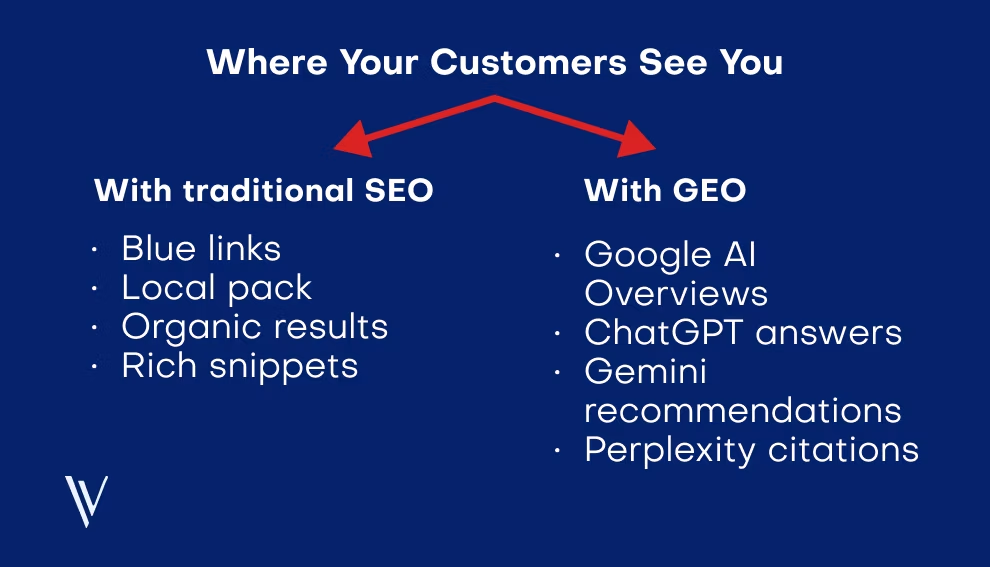
With traditional SEO, your business appears on Google's search engine results page:
- Blue links
- Local pack
- Organic results
- Rich snippets
With GEO, your business appears inside:
- Google AI Overviews
- ChatGPT answers
- Gemini recommendations
- Perplexity citations
More customers are skipping traditional search and asking AI for direct recommendations. And every quarter you neglect GEO, you'll have to pay 10X as much to gain visibility in AI search.
To ensure your online presence is strong enough to capture these valuable AI citations, start by mastering the fundamentals with my guide to local SEO for contractors.
How You Show Up
With SEO, your business shows up as a blue link, rich snippet, or on the local map pack.
GEO works differently.
When someone asks an AI tool for recommendations, there’s no scrolling at all. Your business either gets mentioned or recommended inside the AI’s answer — or you disappear from the conversation entirely.
And based on 350+ AI visibility experiments my team and I have run across ChatGPT, Gemini, and Perplexity, we know one thing for sure: AI likes businesses with structured content and strong authority signals (more on that later).
To make sure your foundational local authority is rock solid before tackling AI recommendations, check out my proven strategies for Google Maps SEO.
How Success Is Measured
With SEO, success is measured by rankings, clicks, traffic, and conversions.
GEO measures something earlier in the journey:
- AI citations
- Brand mentions inside AI answers
- Frequency of recommendations
- Visibility in AI Overviews
The beauty is, AI shows fewer choices per prompt. If you’re the one it recommends, your chances of getting the lead are far higher!
Want to turn your AI visibility into actual revenue? Check out my guide on AI ROI.
But the REAL Measure of Success? True ROI
Following my methodology, the strongest indicator of whether SEO or GEO is working is true marketing ROI: how much you invest vs. how many qualified leads you get.
True ROI = Total Marketing Spend / Number of Qualified Leads Generated
This is the only metric that accurately reflects business growth.
Rankings can look great while ROI collapses.
Traffic can grow while real opportunities shrink.
ROI tells the truth!
How to Track True ROI Accurately
True ROI requires:
- Accurate lead attribution across all channels
- Qualification filtering (so you measure qualified leads, not noise)
- Unified reporting across web, calls, forms, ads, and AI
- Lead-to-client conversion tracking
Without proper tracking, ROI numbers lie — and your business could (unknowingly) optimize for the wrong channels.
How to Set Up Tracking the Right Way
I strongly, strongly recommend:
- Google Analytics + Google Search Console
- Call tracking with keyword-level attribution
- Form and chat tracking connected to your CRM
- UTM parameters on every link
- AI-powered lead qualification through the Growth Portal
When everything is properly connected, you can clearly see:
- Which channels produce the best qualified leads
- Which channels deliver the lowest cost per client
- Which channels generate the highest ROI
This is where GEO becomes a major competitive advantage:
Early adopters often see a dramatically lower cost per qualified lead due to less competition inside AI engines.
Read my full ROI guide: How to Measure Marketing ROI.
Get AI to Recommend You First
Still wondering "What is GEO vs SEO?" Let my team help! We'll get you featured in the top AI tools and dramatically boost your lead flow.

GEO vs SEO: The Overlap (And Why You Can’t Ignore Either)
If you’re investing in GEO marketing, the good news is that your existing SEO work gives you a major head start!
SEO and GEO share a common foundation:
- High-quality, helpful content
- Local relevance and authority
- Structured information
- Trust signals (reviews, credentials, backlinks)
- Clear, consistent business details
So it’s not either/or. If you’re doing SEO correctly, you’re already building 70% of what GEO requires.
SEO improves GEO. GEO improves SEO. You need both for full visibility.
Why GEO Matters for Small Business Owners Right Now
My team and I review 100+ small business dashboards every week. Here's what we see:
- Website traffic is declining, even when Google rankings remain strong
- More users skip Google and ask AI chatbots for recommendations
- Competitors are already showing up in AI answers
- Even #1 rankings on Google don’t guarantee AI visibility
AI shows far fewer choices than Google. So, while it's harder to get AI to recommend you, if it does, you'll be winning far more leads.
Conquer Google and ChatGPT
My team makes you highly visible, helping you close even more jobs in 2026. No stress. Just more closed jobs.
How to Improve Your GEO
Content is at the heart of a stronger AI presence.
Here are 4 practical steps my team uses to boost our clients' GEO visibility, without reinventing their SEO strategy.
Step 1: Answer Questions the Way Chatbots Expect
AI systems love direct answers.
Build part of your blog content into a Q&A format, just like someone would type into ChatGPT.
Then, add FAQ sections to key pages like your services, pricing, and processes. AI can easily extract FAQs that begin with "What is..." or "How to..."
And be specific with your answers. These formats dramatically increase your chance of being cited!
Step 2: Use Clear, Explicit Language AI Can Parse
AI needs to see exactly who you are and what you do.
Across your website, be sure to mention your:
- Full business name
- Service type
- City or zip code
- Credentials
- Pricing ranges
- Service areas
Use specific language instead of vague phrases. Example:
Good: “ABC Plumbing provides emergency water heater repair in Miami, FL.”
Bad: “We help homeowners with plumbing issues.”
The clearer the wording, the easier it is for AI to recognize your business.
To see how we apply these exact principles to heating and cooling companies to drive more local traffic, check out my comprehensive strategies for HVAC SEO.
Step 3: Add Structured Elements AI Loves
AI pulls information from structured formats first, because they’re easier to extract as answers.
Rig the game in your favor by using:
- Bullet lists
- Steps
- Tables
- Glossaries
- Definitions
The more structure you give your content, the more likely AI is to feature your business!
Step 4: Expand Beyond Your Website
AI doesn’t rely on your website alone. It scans multiple sources to check whether your business is real and trustworthy.
- Post consistently on platforms like Reddit, Quora, and industry forums where real conversations happen.
- Keep your Google Business Profile active with updates, photos, and FAQs.
- And make sure your social media pages have the same business details (name, services, location) everywhere.
Want deeper tactics you can copy today? Read my breakdown on How to Get ChatGPT to Recommend Your Business.
GEO + SEO: The Best Strategy for Small Business Owners
In 2026, you need to combine SEO and GEO to protect your pipeline.
SEO grows your rankings on traditional search engines like Google.
Digital marketing GEO makes that same content usable inside AI-generated responses.
When you combine the two, you get maximum visibility, whether someone searches on Google or skips straight to an AI-driven search like ChatGPT.
And if you layer in local SEO (strong listings, reviews, and location signals), you'll also get found by local customers in your service area!
Real Case: How GEO Impacts Marketing Results
My team helped the Jacob D. Fuchsberg Law Firm in New York increase qualified case flow by combining SEO with GEO.
Here’s what happened in the last 12 months:
- +1,050% increase in organic AI qualified leads
- +61% increase in AI Overview appearances
- Mentions in ChatGPT, Gemini, and Perplexity for high-value legal topics
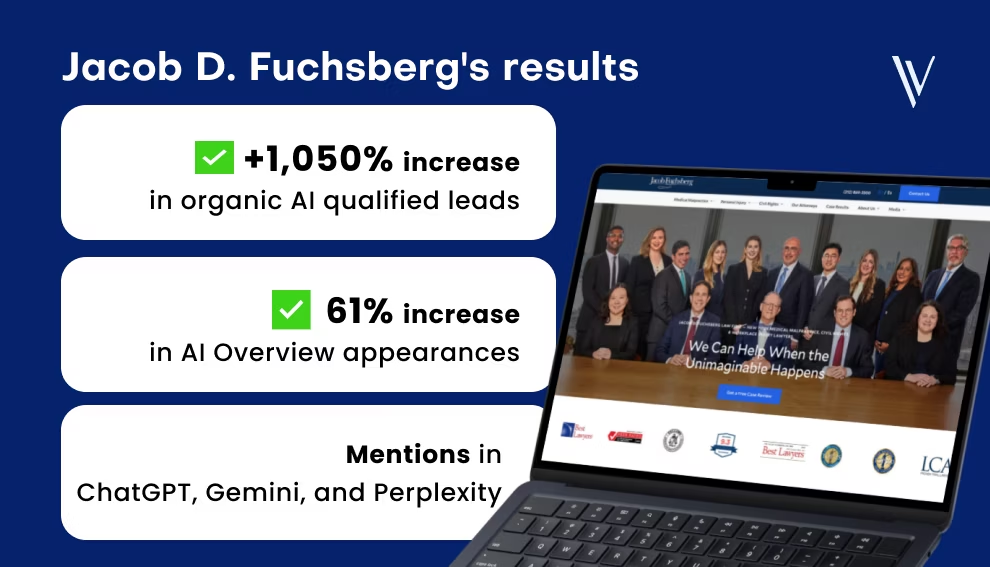
The firm now enjoys a steadier, higher-quality caseload with far greater profitability.
Get Qualified Leads with AI
Your prospects are using AI. Are you being mentioned? Capture their business by optimizing for AI today.
Common Misconceptions: GEO vs SEO Myths Small Businesses Believe
A lot of confusion has hit the market recently as AI models change search. So let’s clear up the biggest misconceptions:
Myth: SEO is dead.
Reality: SEO is the foundation for both Google and AI visibility.
Myth: GEO replaces SEO.
Reality: GEO cannot work without SEO authority signals.
Myth: Ranking #1 on Google = AI visibility.
Reality: AI extracts structured content, explicit details, and factual signals, not rankings.
Myth: GEO requires a totally separate strategy.
Reality: GEO builds on your existing SEO framework.
How to Know if Your Business Needs GEO Right Now
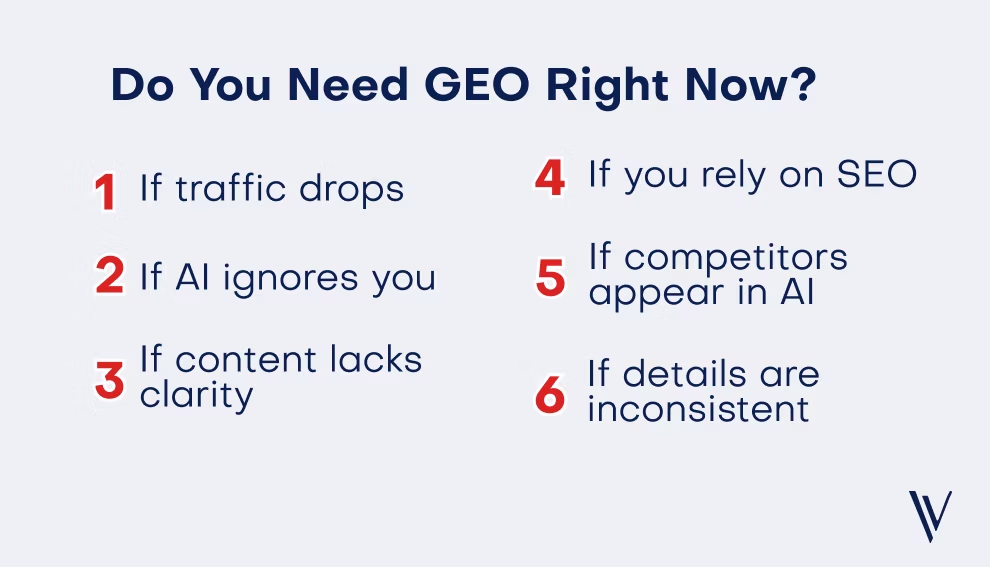
If any of these sound familiar, it’s time to take GEO seriously:
- Traffic is dropping despite stable rankings
- AI chatbots don’t mention your business
- Your content lacks clarity and structure
- You rely heavily on SEO for lead flow
- You see competitors appearing in AI answers
- Your business details are inconsistent across the web
These are early warning signs that you should begin optimizing for AI search ASAP.
Protect Your Pipeline with SEO and GEO
The debate around SEO vs GEO misses the real point.
You need BOTH to protect your pipeline and catch more customers at every touchpoint.
SEO helps them find your website on Google. GEO helps them find you with AI.
In the past 12 months, my team at Comrade has helped dozens of clients in the home services industry gain HUGE traction online with GEO and SEO.
Clients like Cedar Rustic Fence have seen a 461% increase in qualified leads, while Built to Last Roofing saw a 750% lead bump.
If you’d like to future-proof your lead generation like they did, let’s talk, or you can learn more about AI search optimization right here.
.png)
Ivan Vislavskiy is a business growth expert with 18 years of experience. He is also CEO of the award-winning Comrade Digital Marketing. Alongside his team, he’s transformed 300+ businesses across the U.S., with a special focus on the home services niche. His approach is ROI-driven, fully transparent, and built to drive real-world business outcomes.
Schedule a session and skyrocket your business today.


.svg)