
What Is Answer Engine Optimization (AEO): 2026 Guide for Your Small Business
AI is the NEW reality of lead generation. Find out if (and why!) you're not being recommended by AI tools.
Updated:
Dec 12, 2025
Imagine this: A homeowner in Austin discovers a cracked window after a storm.
They open ChatGPT and type: “Who is the best window replacement company in Austin?”
ChatGPT instantly provides 2–3 recommendations. And even though:
- Your company does window replacements in Austin.
- You have excellent reviews.
- Your pricing is competitive.
- You’ve been in business 15+ years.
ChatGPT doesn’t recommend you.
Why? Because AI engines don’t evaluate businesses based on real-world quality. They choose the businesses that have the clearest, most structured, and most consistent signals online.
This is precisely why you need AEO (Answer Engine Optimization). Today, I'll give you 7 tips to become highly visible in AI search and get found by more clients.
What Is AEO? (Explained in Plain English)
Answer Engine Optimization (AEO) is the practice of helping AI tools correctly understand, trust, and recommend your business.
So, when someone asks:
- “Best electrician near me”
- “Top DUI lawyer in {city}”
- “Who fixes water heaters in Austin?”
AI engines scan the web and choose a very short list of businesses to feature.
If your information is unclear, inconsistent, unstructured, or lacking authority… AI simply won't recommend you.
Ultimately, AEO is vital given that over 1 billion people use AI as of 2026. More and more of your potential customers are embracing this new wave of search marketing... so, the question is, are you?
Will AEO Replace SEO?
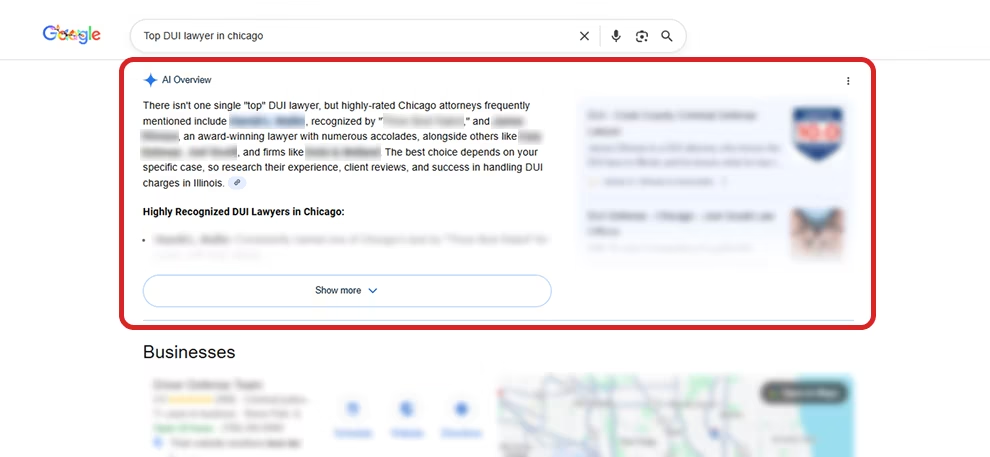
AI engines only recommend businesses that traditional search engines like Google already trust.
Without strong SEO signals (authority, backlinks, reviews, citations), AEO will not work.
So, aside from a robust SEO strategy, you absolutely need AEO (or generative engine optimization) to thrive in an increasingly competitive market.
How AEO Works Behind the Scenes
AI scans websites, Google Business Profiles, online reviews, social profiles, directory listings, and more to decide which businesses to recommend.
In fact, it's so effective that nearly 58.5% of U.S. Google searches now end without a click, because people get direct answers with the AI Overview.
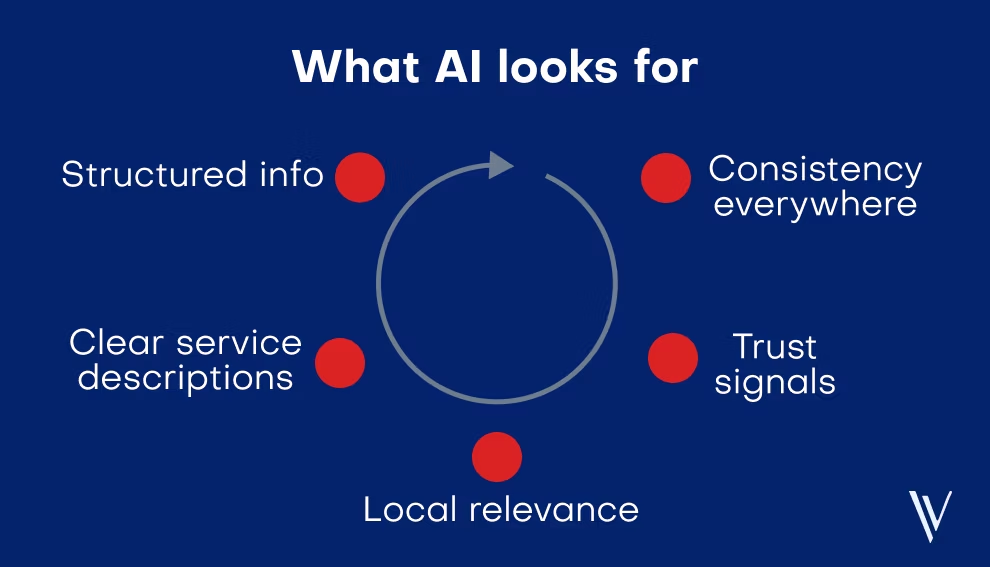
What does AI look for?
- Structured information
- Explicit service descriptions
- Local relevance
- Trust signals (reviews, awards, citations)
- Consistency across all platforms
So, when someone asks ChatGPT: “Best plumber in Austin”, most plumber websites say: “Quality service. Family-owned. 20 years experience.”
AI ignores this as it’s too vague. It would rather see: “We repair water heaters, slab leaks, and drain clogs in Austin, TX. Same-day service available.”
This is clear, factual, and extractable!
Win More Business with AI
My team has helped 100+ clients gain more exposure on AI tools and build a reliable, consistent pipeline of leads.

AEO vs. SEO — What’s the Difference?
SEO and AEO are not separate strategies. They are two halves of the same visibility system.
SEO helps you get discovered on search engine results pages like Google. AEO helps you get recommended by AI tools like ChatGPT.
Why Traditional SEO Must Come First
AI engines ONLY recommend businesses that show strong SEO fundamentals:
- Authority
- Backlinks
- Structured content
- Clean site architecture
- Local citations
- Strong Google Business Profile
Without this foundation, AI won’t consider your business credible enough to cite. This is why businesses trying to “hack” AEO without the SEO investment fail.
Here’s a quick snapshot of SEO vs AEO:
- Where your brand appears:
SEO: Blue links, map pack, and snippets on Google
AEO: ChatGPT, Perplexity, Google AI Overviews, Siri/Alexa responses - How customers find you:
SEO: People search and click
AEO: People ask and get one direct answer - How tools decide what to show:
SEO looks at keywords, backlinks, and search rankings
AEO builds off SEO and looks at clarity, structure, trust signals, and citations - What success looks like:
SEO: Better rankings, more organic search traffic, and leads
AEO: Being included in the answer that users read
Ultimately, SEO drives organic traffic. AEO drives recommendation visibility.
Together, they give you very robust online visibility across all fronts, no matter where your next prospect is!
Why AEO Matters for Small Businesses
58.5% of searches end without a click.
That means even if you rank #1 on Google, 6 out of 10 prospects may never reach your site.
On top of that, tools like ChatGPT handle about 2.5 billion user prompts per day. That's where your best customers most likely are.
And remember, most AI-generated answers feature just 1-5 recommendations, meaning you won't have to compete with 10 blue links (as you would on Google).
Oh, and by the way, it's still early! Your business can still adopt AEO this month and become AI’s “default picks”, often with very little competition.
And I love this one: AEO improves true marketing ROI! This means AI-driven leads typically:
- Convert faster
- Close at higher rates
- Cost less
Curious to see how this impacts your ROI? Check out my guide on Digital Marketing ROI for more real-world numbers.
AEO + SEO for Local Businesses — Your Biggest Growth Opportunity
To recap: SEO inspires trust and authority with Google. AEO builds visibility with AI.
Combine them, and you'll fire on all cylinders. This is vital for local businesses that need to be found fast, especially:
- Home services (HVAC, plumbing, roofing)
- Legal services
- Healthcare & dental
- Real estate
- Wellness & fitness
- Restaurants & hospitality
Real Example: SimVisa (Immigration Law Firm)
I've seen this firsthand. One of our clients, SimVisa, a U.S. immigration service firm, invested in both SEO and AEO, and saw these results:
- +1,350% increase in Google AI Overview appearances (year over year)
- Frequent mentions in ChatGPT and Gemini for immigration-related user queries
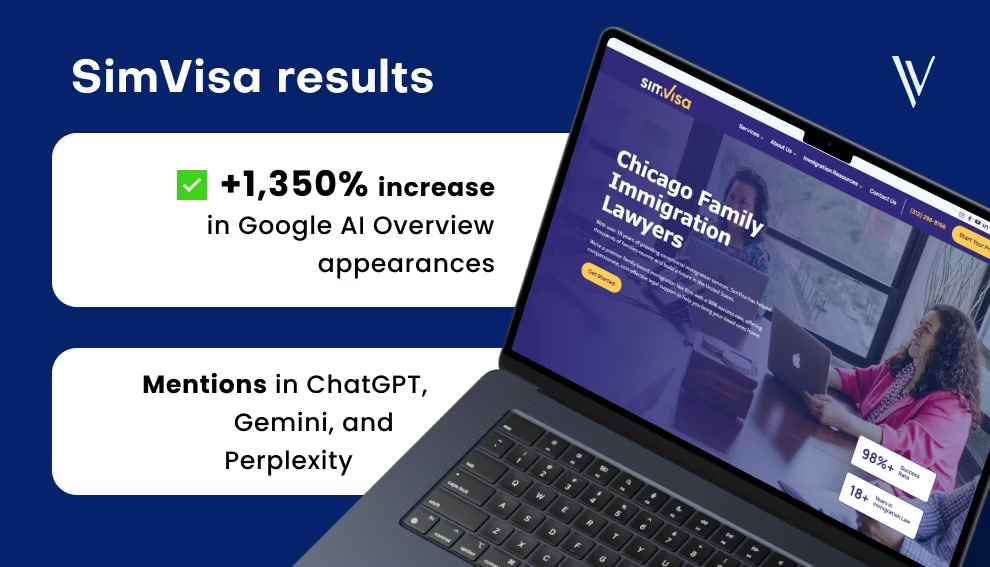
P.S. This type of lift is increasingly common among early adopters!
Ready to Get More Leads?
My pro AI team at Comrade can help. We've 2X'd our clients' lead flow and driven profits with SEO and GEO.
How to Make Your Business Show Up in AI Answers (Simple AEO Steps)
Good news: You don’t need a full website overhaul to start showing up in AI search.
I've dropped 7 smart tweaks below to enable multiple AI platforms to recommend your business when prospects ask for help.
1. Give Direct Answers on Your Website
AI engines pull short, factual statements.
Write in plain English, and explain your services clearly. A good benchmark: aim for a 6th–8th grade reading level. That’s the range most people (and AI) can interpret.
Also, create dedicated pages that directly address common search queries — “What is…?”, “How much does it cost?”, “How to…?”
HVAC Example
Bad: “We handle all your comfort needs.”
Good: “We install and repair AC units, heat pumps, and furnaces in Phoenix, AZ. Emergency repair 24/7.”
When you provide clear, specific answers, you're far more likely to get featured in AI-generated responses.
To see this plain-English strategy in action for heating and AC companies, check out my complete breakdown on SEO for HVAC.
2. Use Headers, Lists, FAQs, and Simple Structure
AI engines hate digging through long paragraphs.
Use a clear structure (headings, bullet lists, and FAQ sections) to help AI instantly locate the exact information it needs. Also, AI looks for extractable sections:
- What we do
- Service areas
- Pricing overview
- How it works
- FAQs
A smart best practice: add 3–5 FAQs to every important service page and provide concise answers to each question.
FAQ Template (ready to paste):
Q: Who is the best {service} in {city}?
A: {Business Name} provides {services} in {city/state}, offering {unique value} and {availability/guarantee}.
Short, direct answers like this help AI confidently give you more brand mentions.
Want to see how this simple formatting helps emergency service brands get recommended by AI? Read my complete breakdown on SEO for restoration companies.
3. Keep Your Business Info Consistent Everywhere
AI tools check your business details across multiple platforms.
Make sure your name, address, phone number, hours, and services match everywhere: your Google Business Profile, Yelp, Bing, Apple Maps, LinkedIn, Facebook, and industry directories.
Lawyer directories to update:
- Avvo
- Justia
- FindLaw
- Nolo
- SuperLawyers
Home service directories:
- Angi
- HomeAdvisor
- Thumbtack
- Yelp
- BBB
Healthcare directories:
- Healthgrades
- Zocdoc
- Vitals
I can't say this enough: Keep your info consistent. Even a minor conflict like Suite #5 vs. Suite 5 confuses AI. You can use tools like BrightLocal, Moz Local, or Whitespark to fix these inconsistencies.
4. Build Trust Signals (Reviews, Mentions, Awards)
AI-powered answer engines love businesses with a strong reputation! Focus on:
- Detailed reviews (mentioning service + city)
- Testimonials
- Awards
- Press features
- Case studies
Focus on collecting quality reviews — detailed feedback from real customers is a major trust signal.
Example Review That Helps AI: “ABC Plumbing fixed my water heater in Austin quickly and professionally.”
These elements feed into what Google and AI models call E-E-A-T: Experience, Expertise, Authoritativeness, and Trustworthiness.
Want to turn your 5-star reviews into a lead-generation machine? See how I do it for outdoor brands in my tree service SEO guide.
Get Cited By AI in 2026!
Your prospects are using AI. Let my team fix your visibility and unleash a flood of new leads.
5. Publish Helpful, Local, Expertise-Based Content
AI recommendations rely heavily on local intent. People rarely search for nationwide answers. They search for solutions near them.
Focus on content that includes your city + service, like: “Best roofer near me” or “Affordable dentist in Miami.” I'll drop a few ready-to-use examples:
Home Services
- “Cost of window replacement in {city}”
- “When to replace vs repair your roof in {city}’s climate”
- “How to detect AC failure early in {city}”
Legal
- “What to do after a car accident in {city}”
- “How long DUI cases take in {state}”
- “Average injury settlement amounts in {city}”
Healthcare/Dental
- “Emergency tooth extraction costs in {city}”
- “How to choose a pediatric dentist in {city}”
When you answer local questions, AI is much more likely to recommend your business.
Want help writing AI-friendly content? Check out my guide on AI Content Optimization.
6. Add Schema (Structured Data)
Have you used schema markup before?
Think of it like adding "labels" so AI can instantly understand what each part of your content means.
It tells search engines and AI tools: this is a service, this is a review, this is a location, this is a price. Important schema types include:
- Local Business
- Services
- Reviews
- FAQs
- Locations
- Pricing
- Service areas
By adding structured data to your pages, you make it easier for AI to extract the right information. Schema dramatically improves how well AI systems can read your site!
7. Check Your AEO Visibility Manually
You don’t need expensive tools to see whether AEO is working. Just ask AI the same questions your customers ask. As an experiment, ask an AI search engine like ChatGPT:
- “Who is the best {service} in {city}?”
- “Which {industry} companies are recommended in {city}?”
- “List top-rated {service} providers near me.”
See which businesses ChatGPT mentions. If you’re not in the results, that’s a clear sign your content needs improvement.
Update your pages with extractable answers (see tip #2 above), strong local signals, and trust elements. Then, after 2 to 3 weeks, ask again. Repeat until AI includes you in its response.
Ready to Close More Jobs with AI?
AI is the NEW frontier. Don't get locked out. My team has helped 100+ clients across the U.S. close more jobs with AI.
How to Spy on Competitors’ AEO Strategy
You can uncover a competitor’s entire AEO footprint in under 2 minutes.
Step 1 — Ask ChatGPT
Type in a question like “Who is the best {service} in {city}?” Then look at who shows up and why.
Step 2 — Use Perplexity
Check the Sources tab. This reveals exactly which competitor pages AI trusts.
Step 3 — Check Google AI Overview
Search: “Best {service} in {city}”. Scroll to citations. Those are the businesses dominating AEO. This becomes your roadmap.
Once you know which competitors AI prefers, visit their websites and study how they structure their content.
How to Start AEO in Less Than 1 Hour (Quick Checklist)
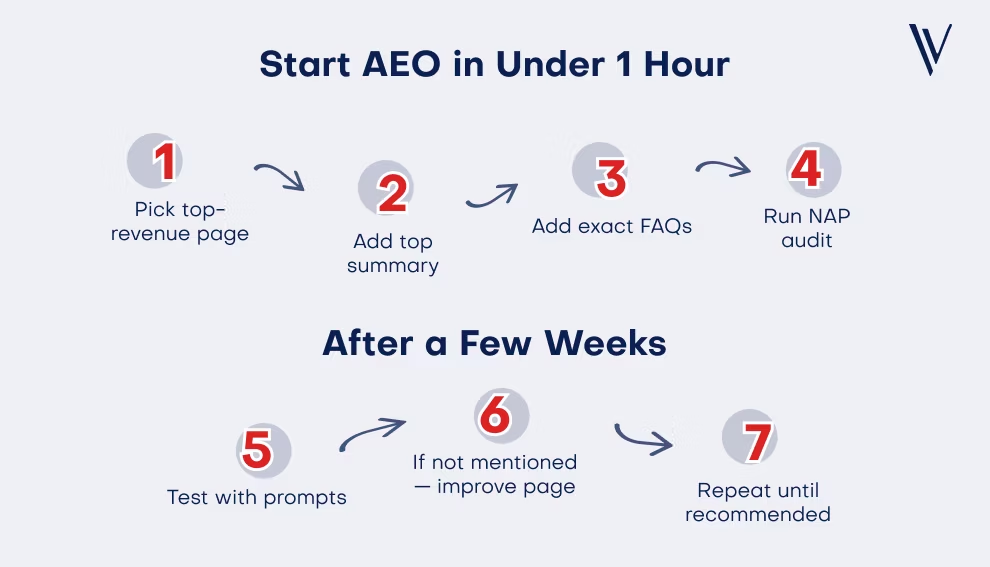
Here’s a fast AEO starter plan you can finish before your lunch break:
- Choose your highest-revenue service page
- Add this summary at the top (copy/paste):
- “We provide {services} in {city/state} with {unique value}. We specialize in {specific services} and serve {service areas}.”
- Add these exact FAQs
- “Who is the best {service} in {city}?”
- “How much does {service} cost in {city}?”
- “Do you offer emergency {service} in {city}?”
- Run a NAP (name, address, phone) audit. Use:
- BrightLocal
- Moz Local
- Whitespark
After a few weeks:
- Test with these prompts
- “Best {service} in {city}”
- “Who do you recommend for {service} in {city}?”
- “Top {service} companies near me”
- If you’re not mentioned — improve the page and ask again
- Repeat until AI recommends you
These are small but mighty steps to gain traction in AI search!
Protect Your Pipeline. Start AEO Today.
Let's summarize: What is Answer Engine Optimization (AEO)?
AEO is the process of making sure AI tools like ChatGPT, Google AI Overviews, and AI assistants like Siri select your business for relevant prompts.
The good news is: AEO isn’t expensive to start! Small improvements like FAQs, stronger local signals, and better reviews go a LONG way.
Would you like to see how AEO can grow your lead flow? Read about AI search optimization here.
And if you're ready to skip to the good part, contact my team today, and let's discuss how you can get consistent, qualified leads from AI.
.png)
Ivan Vislavskiy is a business growth expert with 18 years of experience. He is also CEO of the award-winning Comrade Digital Marketing. Alongside his team, he’s transformed 300+ businesses across the U.S., with a special focus on the home services niche. His approach is ROI-driven, fully transparent, and built to drive real-world business outcomes.
Schedule a session and skyrocket your business today.

![GEO vs SEO: How to Double Your Profits in 2026 [Small Business Edition]](https://cdn.prod.website-files.com/673af32f3d0a33dd056406ce/693a63b8be62ea9d6e9bb15a_geo-vs-seo.avif)
.svg)