
Social Media ROI Guide: How to Achieve a 5X Return in 2026
Likes won't keep the lights on. Follow my 4-step blueprint on how to measure social media ROI and get a HUGE payback in 2026.
Updated:
May 7, 2026
Do you post on social media whenever you "have the time" or "feel like it"?
That’s why your ROI is inconsistent.
Marketing guru, Gary Vaynerchuk, posts 8–15+ times daily and has amassed over 40 million followers as a result!
But of course, followers and likes aren't enough. You need to ask a bigger question: "Is my social media making me money?"
Over the last 18 years, I've found that a good social media marketing ROI typically yields a 5:1 revenue-to-spend ratio ($5 back for every $1 spent).
In just 4 steps, I'll show you how to track your social media marketing ROI — and more importantly, how to turn it into real, consistent profits.
Key Highlights
- Define what success is first; is it likes, calls, quotes, or more booked jobs?
- Use this ROI formula: (Revenue − Cost) ÷ Cost × 100
- Account for full costs, including editing, tools, posting time, and management effort
- Track revenue "signals" like DMs, calls, form submissions, and booked jobs
- Factor in delayed conversions; people may convert weeks after seeing your content
- Review ROI monthly; benchmark it against your margins, not industry averages
What Is Social Media ROI?
Social media ROI (return on investment) is the metric used to evaluate how much value your social media marketing generates compared to what you invest.
To put it simply, what is social media ROI in real terms?
It’s a direct comparison between your social media expenses (ad spend, content, tools, and time) and the outcomes those efforts produce, like leads, booked jobs, and revenue.

But your ROI can be tangible OR intangible. You could tie ROI to sales from a campaign or even brand trust. Naturally, the latter is harder to quantify, but it still influences buying decisions.
A study by Statista found that only 30% of marketers are confident they can measure social media ROI.
That means out of every 1,000 marketers, 700 are blissfully unaware of their ROI!
That's a huge problem I plan to rectify. Your social media marketing efforts need to be ROI-led in 2026.
How to Calculate Your Social Media ROI
My team and I have been doing social media for 18 years.
We’ve perfected a simple formula to measure what your social media is generating. Once you apply it, you'll clearly see whether it's worth your time.
The Best Social Media ROI Formula
The social media ROI formula I use is simple. Most businesses can use this to arrive at accurate results in their social media marketing strategy.
To calculate social media ROI, crunch these numbers:
Social Media ROI (%) = (Revenue from Social Media − Total Social Media Costs) ÷ Total Social Media Costs × 100
That’s how you measure ROI on social media in real terms, by comparing what you earned to what you spent.
For example, if you invest $2,000 into content and ads and generate $10,000 in revenue, your ROI is 400%. It’s the best social media ROI calculation to check your payback.
Want to see your EXACT profits (or losses)? Get my formula on how to calculate your marketing ROI in 2026.
But What About the "Intangible" Non-Monetary ROI?
Remember how I talked about intangible value earlier, like followers and visibility?
Not every result from social media shows up as an immediate monetary value. Things like brand awareness, engagement, and trust still create value.
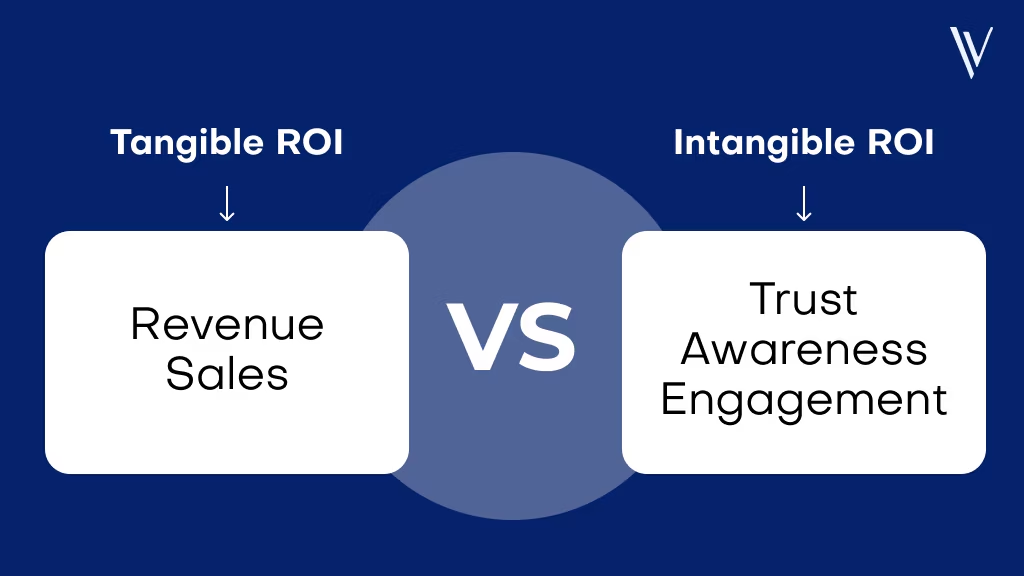
You just need to account for it differently in your social media ROI calculator. Here’s the expanded formula I use in my social media efforts:
Social Media ROI (%) = (Total Value Generated / Total Social Media Costs) × 100
Example: Let’s say you spend $3,000 on social media in one month.
From that, you directly book 5 jobs worth $15,000. That’s your immediate return.
But you also generate 20 solid leads who didn’t convert yet. Based on your past data, you know about 20% of leads usually close, and your average job is $3,000. That means those leads are likely worth $12,000 in future revenue.
So instead of just counting the $15,000 you made today, your total pipeline value is $27,000.
ROI = ($27,000 ÷ $3,000) × 100 = 900%
"Pipeline Value" can include estimated revenue from leads, email sign-ups, or even repeat customers influenced by your content.
This formula is not perfect, but it gives you a far more complete picture of the real return on your social media marketing strategy.
8X Your Returns and Get Clients Faster with Comrade
You're too busy to worry about improving your ROI. Let my team help.

Why You Must Measure Your Social Media ROI in 2026
I can't repeat this enough: Your business can grow SO much faster the day you begin tracking ROI on social media. It directly ties to more business!
Increasing your ROI of social media marketing is critical.
Data Becomes Your Guiding Hand
A McKinsey report confirms that businesses that follow the data are 19 times more likely to be profitable and 7 times more likely to retain customers.
Once you track ROI on social media, things get good. You'll pinpoint exactly which posts or campaigns generate leads and revenue.
For example, a roofing company might find that short storm-damage videos bring in 3X more quote requests than before-and-after photos. Now you know what content to post!
You'll Know Which Platforms and Posts Bring in Jobs
Social media influences over 76% of purchase decisions, as per Sprout Social. The ROI potential is HUGE!
ROI on social media gives you clarity (my favorite word!) on where your money is working.
You might discover Facebook ads are generating leads at $200 per lead, while Instagram generates them at $250 per lead.
Tie Every Post Back to Leads, Calls, and Revenue
Social media should support your business goals.
A landscaping company, for example, might track how many estimate requests come from seasonal promotion posts.
When you connect content to REAL outcomes like calls and revenue, increasing your ROI of social media marketing becomes predictable (another favorite word of mine!).
The AI Explosion Is About to Flood Social Media
AI is about to change everything.
In 2026, content production isn’t the bottleneck anymore. With tools like ChatGPT, Midjourney, and CapCut, anyone can create high-quality posts in minutes.
That means there's more content than ever before. Your audience is drowning in it.
So how do you stand out?
- Personalization → Speak directly to your exact audience (location, problems, timing)
- Your face and voice → People will always trust people over even the most polished AI avatar
- Your story and opinions → This is what AI can’t replicate, it can only mimic generic human emotions
If your content feels generic, it will get buried. Use AI to scale content, but keep it human, personal, and specific.
Why Social Media ROI Is Tricky to Pin Down
You're not crazy. Estimating your social media ROI is hard.
But it isn’t hard because it doesn’t work; it’s hard because most businesses track it wrong. It gets complicated when you don’t account for how people actually buy.
Your Leads Don’t Convert on the First Click
This is one of the BIGGEST issues I see. Someone watches your Instagram video today, then calls you two or three weeks later.
You might credit that lead to Google or direct traffic, but the first touch happened on social. That time gap makes your social media ROI look weaker than it actually is.
Trust is a Factor (Even Though You Can’t Price It)
Not every result shows up as immediate revenue. I’ve had contractors tell me their customers say, "I’ve been following you for a while."
That trust didn’t happen at the snap of a finger. It was built through content, and it directly impacts conversion rates, even if it’s harder to assign a dollar value.
Customers Bounce Between Channels Before They Call
It takes 7 touchpoints on average before a customer converts.
A homeowner might see your Facebook post, check your reviews, visit your website, and then click a Google ad before calling.
If you only credit the last step, you miss how social media strategy contributed along the way.

Your Data Is Scattered and That "Breaks" Your Visibility
Here’s the operational problem: your data is everywhere.
Facebook Ads, Instagram insights, your CRM, call tracking, and Google Analytics — they're all part of the story.
But if you don't unify them, you'll make decisions based on incomplete data.
Centralize your social media platform data. Use a dashboard or system that pulls everything into one place so you can see leads, costs, and revenue side by side.
That’s exactly why my team built our Client Portal to connect every channel back to leads, revenue, and profits.
My 4-Step Blueprint to Calculate Your Social Media ROI
Time for action.
If you want to truly improve your social media ROI, you need a clear process. This is the exact framework I use to connect social media activity to real leads and revenue.
- Define what "success" means for your business (calls, estimates, booked jobs)
- Track actions that lead to revenue (focus on leads and conversions)
- Add up every dollar you’re investing (ads, content, tools, and time)
- Review social media performance (and adjust regularly)

Step 1: Define What "Success" Means for Your Business
For years, my social media ROI never made sense.
Then I realized it was because I didn't define what success looked like upfront. I ended up tracking random social media metrics that didn't tie back to revenue.
Set Clear Goals for Brand Awareness
Awareness isn’t just "more people seeing your posts."
It’s about reaching the right audience. For example, a roofing company could focus on homeowners (aged 35+) in storm-prone areas. Going viral and getting 1M likes isn't always good for business.
The goal is visibility that eventually turns into qualified inquiries.
Set Clear Goals for Engagement
I'll die on this hill: Likes are surface-level, but comments, DMs, and shares show real interest.
I’ve seen contractors land estimate requests directly from comment threads. THAT'S the kind of engagement that drives results in your social media campaigns.
Set Clear Goals for Conversions
This is where ROI comes to life. Track actions like form submissions, phone calls, and quote requests. If your social media isn’t generating these, your ROI will always look weak; no matter how active you are.
Set Clear Goals for Customer Loyalty and Referrals
Social media shouldn’t stop at the first job. Every competent social media manager will tell you that.
For example, one backyard project worth $6,000 gets posted. The homeowner shares it, which leads to 2 referrals. One of those turns into another $5,000 job. A few months later, the original client books $1,500 in maintenance.
That’s $12,500 generated from one initial job, and that long-term value (and even your customer lifetime value) is part of your ROI, even if it shows up later.
Step 2: Track the Right Metrics
Clients come to me excited about thousands of likes and views, but when I ask how many leads or jobs came from it… silence.
That’s the problem. Most businesses track the wrong social media ROI metrics.
If your goal is ROI, don't just look at engagement metrics. You need to micro-focus on revenue. Here’s how I break it down:
For example, I worked with a contractor who had viral videos that were getting thousands of views, but zero calls. Once we shifted the focus to tracking DMs and quote requests, they started seeing consistent leads.
That’s the difference with tracking key metrics. When you focus on the right social media ROI metrics, you start generating business.
Need Help Calculating Your Returns?
We'll give you a clear picture with a step-by-step plan to boost it by 800%!
Step 3: Monitor Every Dollar Going Into Your Social Media
This is where most ROI calculations fall apart.
I had a roofing client who told me their social media was "cheap." They were only spending $1,500/month on ads. I was surprised. Then I asked a few more questions.
They had a marketing assistant posting daily. A freelancer editing videos. Two software tools. And the owner reviews content every week.
When we added it all up, they weren’t spending $1,500; they were closer to $4,500/month.
That changed everything. If you want accuracy when calculating ROI for social media, you need to track your full social media investment. Here’s what that includes:

Your Paid Ads Budget (The Obvious Cost)
This is the easy one; your ad spend on Facebook, Instagram, and TikTok ads. It’s visible and trackable, but it’s only one part of your total spend.
The Cost of Creating Content
Videos, photos, captions, editing; whether outsourced or done in-house, content takes time and money. Ignoring this in your social media accounts messes up your numbers big time.
The Time Your Team Spends Managing Social
If someone is posting, replying to comments, or managing campaigns, that time comes with a salary. Be sure to include your own time, too.
The Platforms and Tools You Pay For
Scheduling tools, analytics platforms, CRMs; these subscriptions support your strategy and need to be included in your total investment.
The Systems You Use to Track ROI
The best tools to track social media ROI bring your data into one place.
That’s why I recommend using a centralized social media ROI tool or dashboard like HubSpot or Sprout Social to track leads, calls, and conversions.
Most social media marketing ROI statistics look great on paper because they ignore these hidden costs. That's why you must use a good social media analytics tool to stay in the know.
But watch out for the cliff! After a certain point, you'll face diminishing returns. Read my article to spot the signs.
Step 4: Turn Your Data Into Better ROI Decisions
To quote marketer Dan Zarrella, "Marketing without data is like driving with your eyes closed."
This is where it ALL comes together. Tracking your numbers is one thing. But the real money move is knowing what to DO with them.
Once you have your data (leads, costs, and revenue), you need to look for patterns in your social media content marketing strategy.
Which campaigns are generating the most qualified leads? Which posts are actually leading to calls or quote requests? And just as important, what’s not working?
For example, one campaign might bring in 20 leads, but only 2 turn into paying jobs, while another brings in 10 leads and closes 5. The second one is far more valuable.
This is exactly why it's critical to have everything in one place. In our Client Portal, we bring together our clients' leads, cost per lead, channels, ROI, and revenue.
That's how we grow their ROI consistently.
7 Simple Steps to Increase Your Social Media ROI
This is the exact process I’ve refined over the last 18 years to improve social media ROI.
Simply put, we'll focus on what drives revenue, and consistently optimize what works.
Test Everything — Small Changes Can Double Your Results
As the "Father of Advertising," David Ogilvy once said, "Never stop testing, and your advertising will never stop improving."
I never assume anything will work. I had a client convinced their ad headline was perfect, until we tested a simpler version and conversions jumped by 40%.
Test your headlines, visuals, offers, and calls-to-action. Small tweaks can significantly improve your social media advertising ROI.

Post When Your Audience Is Ready to Take Action
Timing matters more than you think. I’ve seen contractors post great content at the wrong time and get nothing. Then we shift it to evenings or weekends (when homeowners are active online) and leads start pouring in like a faucet. Use your data to find when your audience is most active and ready to engage.
Make It Easy for People to Request a Quote Instantly
For home services, this is huge. Don’t make people jump through a ring of fire. I worked with a remodeling client who added a simple "Get a Free Estimate" button at the top of their Facebook page and started getting direct inquiries every week. The easier it is to act, the easier it is to track your social media advertising ROI.
Go Hard on Content That Brings in Leads
Your data will tell you what works, IF you pay attention. I had an HVAC client posting a mix of content, but when we dug into the numbers, one 30-second video on "why your AC isn’t cooling" generated 12 calls in a week. Once we saw that, we doubled down on similar problem-based videos. Within a month, video content was driving over 30% of their inbound leads.
Use Video to UP Your Trust Faster (Especially Now)
With AI-generated content everywhere, your audience is craving something real.
That’s why short videos are killing the game.
I’ve seen contractors get consistent inbound calls just by posting simple, face-to-camera videos explaining common problems:
- "The #1 reason your AC isn’t cooling…"
- "Check THIS before calling an electrician…"
Keep in mind, 21% of marketers say short videos (under 3 minutes) deliver the highest ROI. All in all, video content inspires major confidence in a nervous buyer and directly boosts your ROI.
Repurpose Everything (Don’t Create Once and Forget)
One of the biggest mistakes I see is reinventing the wheel. Businesses happily create a piece of content and then forget about it.
My advice is to stretch every piece of content across multiple platforms. Let’s say you film a 10-minute video about "Why your AC isn’t cooling properly."
- Post shorter clips from the video on TikTok, Instagram Reels, and YouTube Shorts to reach different audiences
- Turn the main points into a carousel post like "5 Reasons Your AC Isn’t Cooling"
- Rewrite the content into a short blog post or email explaining the issue in more detail
- Pull out quick tips (like "check your filter first") and schedule them as separate posts throughout the week
This is how you multiply your ROI without multiplying effort!
Use Your Data to Target Better
Tracking ROI on social media shows you WHO converts. One of my roofing clients targeted a wide audience across an entire state, bringing in leads at $300 each, and most weren’t even in their service area.
Once we narrowed it down to homeowners within a 20-mile radius who recently searched for roof repairs, the cost per lead dropped to $120, and close rates improved. Knowing these nuances helps contribute to a positive social media ROI.
Don't stop there! Read my full article on how to boost your marketing ROI in 2026.
What is a Good Social Media ROI?
Once you calculate your numbers, the next question is obvious: Is this good?
There’s no single number that works for everyone. The average ROI for social media marketing often lands around 4:1 to 5:1, meaning $4–$5 back for every $1 spent.
But I’ve seen it vary a LOT. Consider this example:
What I always tell clients: Don’t chase industry averages. Focus on your own profitability.
If your social media is consistently bringing in more revenue than it costs, you’re on the right track. From there, it’s about improving over time. If you were getting a 3:1 return last quarter and now you’re at 4:1, that’s progress.
At the end of the day, a "good" ROI grows your business and gives you the confidence to keep investing.
Final Reminder: Your ROI Could Be So Much Higher!
Take action to boost your marketing returns by 820% at Comrade.
My Nifty Blueprint to Create a Social Media ROI Report
Stick with me, this is a little detailed, but it can be very simple once you get the hang of it.
Start with revenue
Lead with what matters: total revenue from social, cost per lead, and overall ROI. If it doesn’t tie to money, it’s secondary.
Show the funnel, not just the top
Map views → clicks → leads → booked jobs. This makes it clear how social media actually contributes to your pipeline.
Break it down by campaign and channel
Identify which ads, posts, or platforms are generating the best results, so you know exactly where to scale.
Visualize your social media data clearly
Use simple dashboards or charts instead of spreadsheets so trends are obvious at a glance.
Connect everything to business outcomes
Don’t stop at customer engagement. Show how those interactions turned into calls, quotes, and revenue.
End with clear next steps
Spell it out: increase budget here, cut this campaign, test this format next. A good report drives action.
Centralize your data in one place
Social media tools or dashboards help you see leads, costs, and revenue together to make better decisions and acquire more social media customers.
Time for Action! Let's 8X Your Marketing Returns in 2026.
Your social media ROI is one tiny part of a bigger puzzle.
The competition is brutal. You cannot be profitable by solely relying on ROI-focused social media services for brands.
The businesses that make crazy amounts of money unify multiple channels to capture demand at every stage.
Partner with my team at Comrade. We've transformed 330+ businesses to generate more leads consistently with SEO, AI search optimization, and PPC.
Take Cedar Rustic Fence. They relied heavily on referrals and had no predictable pipeline. Once we implemented a full digital strategy, they saw a 4,618% marketing ROI and a 461% increase in qualified leads!
Don't sit around praying for a miracle.
Book a consultation and let's scale your leads, revenue, and profits together.
.png)
Ivan Vislavskiy is a business growth expert with 18 years of experience. He is also CEO of the award-winning Comrade Digital Marketing. Alongside his team, he’s transformed 300+ businesses across the U.S., with a special focus on the home services niche. His approach is ROI-driven, fully transparent, and built to drive real-world business outcomes.
Schedule a session and skyrocket your business today.
.webp)


.svg)