
Your 2026 AI Business Strategy: 5 Steps to Multiply Your Revenue
AI has entered the arena! Do you have a robust AI for business strategy to compete in 2026?
Updated:
Dec 10, 2025
It's 2026, and AI is officially running the show.
Today, it helps businesses automate customer service, predict demand, streamline supply chains, and do so much more.
I recently read a McKinsey report that suggested advanced AI could unlock between $3.5 and $5.8 trillion in value every year — yes, that’s trillion with a ‘T’!
You absolutely, positively need an AI strategy to stay profitable.
And no, you don’t need engineers or a huge budget. Let’s start with 5 strategic moves that lay out how to use AI to grow your business in 2026.
What is an AI Business Strategy
An AI business strategy is a clear plan for how AI will improve your operations, decision-making, customer experience, and long-term performance.
Ultimately, your AI strategy for business must connect these 4 core elements:
- Technology — the right AI tools and infrastructure
- Data — clean, organized information feeding smarter insights
- People — teams trained to use AI confidently
- Processes — workflows redesigned to take advantage of AI-powered automation
78% of businesses are using AI in at least one business function, and you'll soon see why!
Since 2022, I’ve seen that gap widen fast: those with a real AI strategy scale… everyone else gets locked out of their market. Every quarter you wait, it gets harder and harder to catch up.
Why AI Business Strategy Is Vital for Your Business's Growth
44% of companies using AI report lower operating costs, often within the first year!
But in my experience, AI is a growth engine only when it’s embedded with a strategy in mind.
Build a robust AI strategy for business to streamline how you operate, plan, and innovate. Here’s what that looks like in the real world:
- Reactive to proactive
Most teams wait for problems to show up in reports. With the right AI systems, you get real-time insights and predictive analytics that help you act early. - Guessing to knowing
AI implications for your business strategy include spotting revenue trends before they peak, and moving fast. - Hidden gaps to new opportunities
When you implement AI, it reveals unmet customer needs and helps you align your strengths to meet demand first.
I’ve seen it firsthand at my marketing agency, Comrade — with AI adoption, we're able to catch winning strategies early on, driving our clients’ ROI as high as 800%.
Ready to Grow Faster with AI?
Schedule a free audit with my team. We’ll spot your revenue leaks and give you a clear roadmap to multiply your profits.

How to Use AI to Grow Your Business
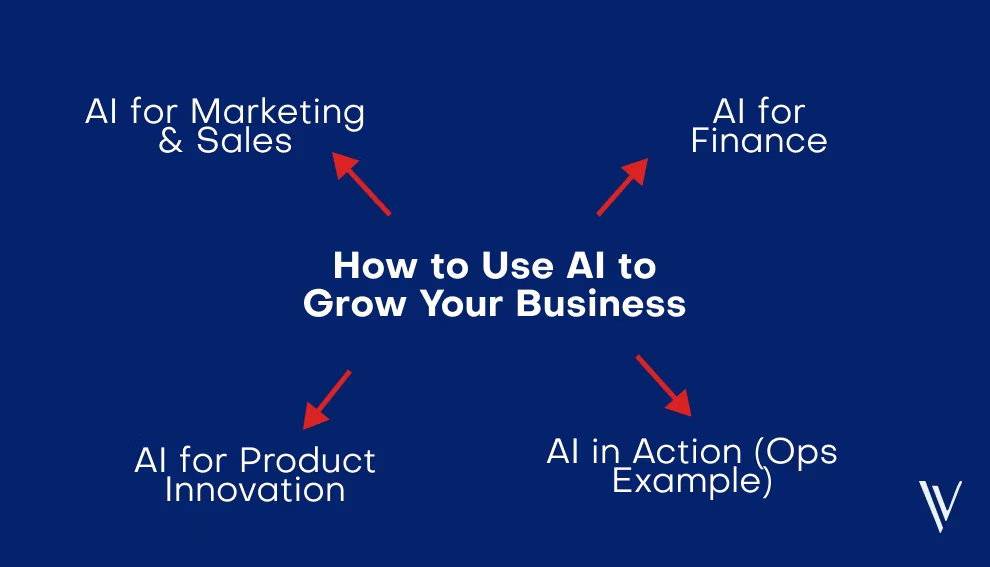
Let’s take this from theory to execution. Here are 4 areas you should start using AI technologies to grow your business: marketing, operations, finance, and innovation.
AI for Marketing and Sales
Across 400 cases, McKinsey found that AI in business strategy contributed the greatest value to marketing. Here's how:
- Personalization at scale
AI tools tailor your ads, emails, and SMS campaigns to what each person cares about. - Automated lead response & nurturing
Generative AI chatbots reply instantly, qualify leads, and ask the right questions. - Predictive demand forecasting
AI can spot patterns your team can’t. For example, roofers can use AI to predict storm-driven demand in specific neighborhoods weeks ahead — so they can staff up, stock materials, and win the business before competitors even know it’s coming.
And yes — this directly ties to AI for business growth.
Learn how to implement these AI strategies and scale your pipeline in our ultimate HVAC Digital Marketing Guide.
AI Engine Optimization (AEI): The New Way Customers Discover Businesses
There’s a major shift happening right now in how people search.
Instead of browsing Google results, buyers are asking ChatGPT, Claude, and Perplexity questions like:
- “Who’s the best divorce lawyer in Miami?”
- “Find me a roofer who can fix storm damage tomorrow.”
- “Recommend a marketing agency for small businesses.”
These AI assistants don’t show a list of websites as Google does. Instead, they recommend one or two businesses they trust. That shift is creating a new discipline: AEI — AI Engine Optimization.
AEI vs. SEO: What’s Changing?
In our early testing, 70–75% of all AEI-driven leads come directly from ChatGPT, and they close at nearly DOUBLE the rate of traditional search leads!
AI for Operations and Efficiency
A strong AI strategy for business clears the way for operational efficiency and higher profits:
- Automates repetitive tasks like scheduling, billing, and job reminders, freeing your team for higher-value work.
- Reduces errors in data entry, intake, and logistics — fewer mistakes, fewer costly delays.
- Optimizes resources by predicting staffing and supply needs so projects stay on time.
Dental clinics are already using AI to predict which patients are most likely to no-show, automatically sending extra reminders or filling gaps to keep the schedule running at full capacity.
For business leaders, the best AI strategy for business growth ultimately makes you more productive without the payroll burden.
Real-Life Example of Using AI in Operations
This is exactly why my team at Comrade built our AI-powered Client Growth Portal.
It uses AI to automatically qualify leads, drive revenue projections, and even pinpoint winning strategies across 100+ campaigns.
That way, our clients get full transparency and multiply their revenue from day one... with no pointless trial and error.
Case in point: One of our clients, Built to Last Roofing, saw a 4X qualified lead increase in the first 6 months!
AI for Financial Management
A strong AI business strategy even gives you clearer control over money:
- Cash flow tracking
AI applications monitor spending in real time and flag issues before they hit your bank account. - Potential risk and fraud detection
Smarter alerts catch billing errors and suspicious activity instantly. - Profit forecasting
AI predicts revenue and margins so you plan with confidence.
For instance, with PI law firms, AI-powered intake instantly qualifies leads based on case value, helping personal injury attorneys focus on the highest-ROI opportunities!
These are powerful AI implications for your business strategy, helping you make smarter financial decisions every week.
AI for Product Development and Innovation
Your AI for business strategy also helps create and improve offerings faster. How? By making decisions more data-driven:
- Market and feedback insights
AI analyzes reviews, trends, and customer behavior instantly — no more long research cycles. - Faster prototyping + iteration
AI also reviews key performance indicators, tests ideas quickly, refines what works, and drops what doesn’t.
It's undeniable: Using AI in your business strategy drives smarter innovation.
Get Your Free Growth Plan
AI is taking over the world. Adapt today and you'll dominate your market for years to come. Ready to boost your ROI with AI?
Designing the Best AI Strategy for Business Growth
Here's my 5-step plan to design the best AI strategy for business growth. This will tie AI technology directly to your revenue.
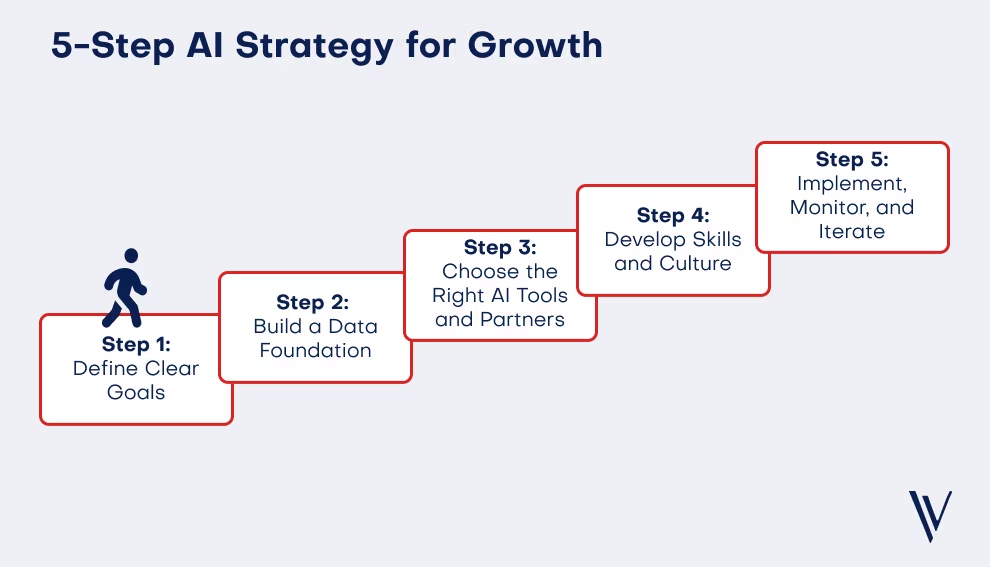
Step 1: Define Clear Goals
Every successful AI business strategy starts with one question: What will this improve?
The goal isn't AI. It's profit and growth. So before choosing your tools, define the exact metrics you want to move. Do you want to:
- Increase qualified leads?
- Cut scheduling or admin time by 30%?
- Improve close rates or reduce missed appointments?
Tie each AI initiative to a measurable result and a deadline. When you anchor AI to revenue, efficiency, or customer experience, it’s much easier to track what’s working.
If you can’t tie it to growth, don’t do it.
Ready to define the goals that will actually move the needle? Start by building a solid foundation with my guide on drafting a HVAC business plan!
Step 2: Build a Data Foundation
Next, your AI in business strategy needs solid data behind it. I always say, AI is only as smart as the information you feed it.
For long-term success, I'd start by cleaning and organizing the basics:
- Customer details (accurate contact info, service history)
- Revenue + job data (what sells best, in which areas)
- Lead source tracking (what channels produce buyers)
- Scheduling + operational data (no-shows, cycle times)
- Reviews + feedback (structured, easy to analyze)
After you add these steps to your Artificial Intelligence strategy, there's one more important thing you need to do.
Centralize Your Data!
Is your information scattered across different platforms? When customer data, call tracking, financial information, and campaign performance all live separately, AI CANNOT connect the dots.
I'd recommend centralizing your data. This allows AI to:
- Detect patterns across channels
- Predict demand and customer behavior more accurately
- Automate tasks with full context
- Improve performance continuously, not reactively
It’s why we built our Growth Portal to centralize leads, revenue, traffic, call tracking, ROI projections, and so much more, allowing AI to help us multiply our clients' returns exponentially.
Step 3: Choose the Right AI Tools and Partners
A smart AI strategy for business means picking tools that solve real problems. Start simple:
- Begin with affordable tools
Many AI platforms automate scheduling, intake, and marketing for little to no cost. - Scale up as needs grow
Upgrade to enterprise solutions only when you need deeper analytics or custom automation. - Choose the right partners
Work with vendors or agencies who actually use AI in their own operations, not just pitch it.
To find the right tools, check out my guide: 15 Best AI Tools for Business.
Step 4: Develop Skills and Culture
Tools alone won’t transform a business — your people will. One of the biggest AI implications for your business strategy is the need to get your team comfortable using AI every day.
- Train for AI literacy
Show employees how AI helps them do their jobs faster, not replace them. - Address resistance early
Fear of change is natural. Be transparent about your business objectives and celebrate quick wins. - Build a test-and-learn mindset
Encourage small experiments: “Try this AI tool for a week and track what improves.”
When your team sees AI as support, you unlock some serious performance gains.
AI + Humans: The Hybrid Model That Wins
My team of over 100 people at Comrade uses AI across our operations, and I can confidently say: AI doesn’t replace great teams, it multiplies them.
AI streamlines our speed, research, pattern detection, and execution at scale. While humans deliver strategy, judgment, creativity, leadership, and connection to our clients.
I'd recommend a hybrid model where:
- Leaders use AI for smarter decision-making, not job elimination
- Teams gain confidence by using AI as a daily skill, not resisting it
- Human insight continues to guide and validate what AI recommends
As AI tackles the monotonous work, your people can focus on better service, innovation, and nurturing relationships.
Step 5: Implement, Monitor, and Iterate
This is where AI for business growth becomes real. Don’t roll out AI everywhere at once — start with a simple pilot that solves one clear problem.
- Launch a pilot project
Test one workflow or department to prove value quickly. - Track the results
Measure the exact metrics you set in Step 1 — leads, time saved, revenue gained. - Scale what works
Once it’s successful, expand step-by-step into other areas. - Improve continuously
Get team feedback, refine, and let AI learn as you grow.
After overseeing 100+ client campaigns, I've personally seen it: Small wins compound FAST. That’s how AI drives predictable, repeatable growth.
Work With a Team Already Using AI
My team uses AI-driven data across 100+ winning campaigns to give you a serious edge. Ready to scale faster with AI?
Real-World Examples of AI in Business Strategy
In 2026, companies (big and small) are already proving the impact of AI in business strategy.
Retail giant H&M uses AI to forecast demand and optimize stock levels across stores, reducing waste and improving margins.
This is a major shift from slow, manual seasonal planning to real-time decisions that boost efficiency — a clear example of how to use AI to grow your business!
Church Brothers Farms — a regional agribusiness — improved demand-forecast accuracy by up to 40% using AI to analyze 100+ product-group signals.
That allowed them to shift toward production based on actual demand, cut carrying costs, and protect profits even when market conditions changed.
Bear in mind, AI implementation isn't just for the giants. It’s creating measurable growth even for smaller businesses. Check out my article: 5 Small Biz Tricks to Get Big-Time Returns!
Common Mistakes in AI Business Strategy
All that being said, I can tell you, even the best-intentioned teams can stumble when introducing an AI project into their operations.
Here are the top pitfalls to avoid:
Relying on technology alone
AI models will not replace leadership. The strongest AI strategies pair automation with human expertise. This is what guides your decisions, validates outputs, and aligns your tech with real-world goals.
Weak or fragmented data foundations
AI can only analyze what it’s given. When data is messy or scattered across systems, predictive models fail. Clean, centralized data is your competitive advantage.
Trying too many tools without a strategy
Teams jump into machine learning with dozens of disconnected tools, hoping one will be their "silver bullet". Without a clear plan, this creates confusion, wastes money, and delivers ZERO measurable outcomes.
Treating AI as a “one-and-done” implementation
AI is a capability. It requires continuous refinement, updated insights, and new use cases as your business evolves.
No execution or follow-through
Teams get excited about insights, then never implement them. AI must be tied to pilots, measurement, iteration, and real business change — or it becomes an expensive experiment.
Lack of team training and AI literacy
When teams don’t understand how to use AI or why it matters, adoption stalls. Early training and clear communication are critical to long-term success.
No clear ownership of AI initiatives
If “everyone” owns AI, no one owns AI. Assign responsibility for ROI, results, and continuous learning... or progress disappears into the day-to-day.
The Future of AI in Business Strategy
AI is about to reshape the competitive landscape permanently. What’s coming next?
- Mainstream adoption
By 2030, 80% of enterprises will rely on AI for mission-critical decisions (Gartner). The winners will be those building the best AI strategy for business growth today. - From automation → prediction → autonomy
AI won’t just speed up tasks — it will proactively prevent problems, forecast demand, and even recommend strategic moves before competitors notice a shift. - Continuous evolution becomes mandatory
The biggest AI implication for your business strategy is adaptability. Teams must upgrade skills, test emerging technologies, and refine processes every quarter to stay ahead. - Personalization is at the core of every business
Products, services, and customer experiences will increasingly be tailored in real time — no more “one-size-fits-all” markets.
Unlock Your Business Growth with an AI Strategy
I know this was a lot to take in. Here’s the quick recap of what matters when designing an effective AI business strategy:
- Start with clear, measurable business goals tied to revenue
- Build a clean, organized data foundation
- Choose AI tools that support your strategy (not the other way around)
- Train your team so adoption sticks
- Test small, learn fast, and scale what works
AI for business growth is vital as a competitive edge.
Thankfully, you don’t need to figure it out alone. My marketing agency, Comrade, uses AI daily to drive higher ROI with top-tier SEO, paid ads, and web design services.
It's how Cedar Rustic saw a 4,618% marketing ROI and Chicago Eyelid Center saw a 13,081% ROI.
Curious to see where AI can take your business? Contact us today and get your free growth plan.
AI Business Strategy FAQs
.png)
Ivan Vislavskiy is a business growth expert with 18 years of experience. He is also CEO of the award-winning Comrade Digital Marketing. Alongside his team, he’s transformed 300+ businesses across the U.S., with a special focus on the home services niche. His approach is ROI-driven, fully transparent, and built to drive real-world business outcomes.
Schedule a session and skyrocket your business today.


.svg)